Showing posts with label peru. Show all posts

Friday, November 28, 2008

skywatch friday, week 16


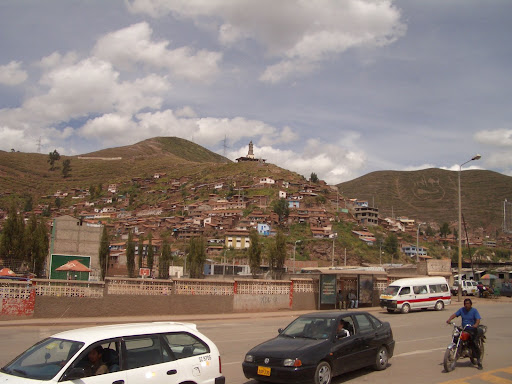
[chinchero, peru, june 2007]

How embarrassing: here I am posting on Skywatch Friday, and my last post was... last Friday. A whole week has gone by and my poor little blog has no writing to show for it. Worse still, today's photo is not even recent; it's from my archives, nearly a year and a half old. Oh well, at least it's a cool-looking sky, right? At the very least, you can surely find a cool-looking sky at skywatch.

Thursday, October 30, 2008

peoplemovers

I have long nurtured a fascination with mass transit systems. I can't quite say why, nor can I pinpoint when it started, but I think I first became conscious of it while studying abroad in Alcalá de Henares, a suburb of Madrid.

A "suburb" in Spanish is called a cercanía, and Cercanías is what they call the regional rail networks in Spain. The Cercanías trains are what we would take from Alcalá to get into Madrid. It was four years ago, but if I stop to think about it, I can still hear the voice that announces the stops in that beautiful Castilian Spanish, theta and all: Próxima parada: Torrejón de Ardoz.

My love for the Madrid Metro was instantaneous. One of the oldest Metro systems in the world (first opened in 1919), it's sleek, efficient and enormous. My explorer buddy and I had many an adventure navigating the capital city via its underground labyrinth of Atochas and Sols and Nuevos Ministerios. Years later, while Julie was again living in Spain, she sent me the link to Red Retro: a sort of underground (pun intended) guerrilla art project involving altering the names of Metro stations. A delightful endeavor, if you ask me.

When we arrived in Barcelona at the end of our 2004 stay in Spain, we realized just how accustomed we had become to the Madrid Metro: we experienced some embarrassing difficulty entering the Barcelona Metro, since the turnstyles, in relation to where you inserted your ticket, were oriented opposite the way they had been in Madrid. The Barcelona Metro has a different flavor: it's smaller than Madrid's, and everything is in three languages. The Catalan influence means that "RENFE" (originally an acronym for the Spanish National Rail Network) is pronounced with a schwa at the end (which is a shocking phenomenon when you have been hearing only Spanish for the last three months), and that Metro stations have names like Paral•lel. Yes, that's really how it's spelled.

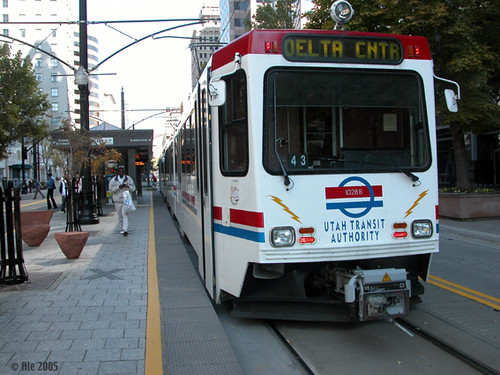
I take a certain pride in having experienced several mass transit systems around the world, from the smooth and sometimes architecturally grandiose Washington DC Metro of my homeland, the somewhat chaotic New York City Subway, the aging T of Boston, the endearing UTA buses in my last area and the promising TRAX light rail in Salt Lake City, Chicago's El trains and Metra commuter rail (which we like to think of as a female Metro), to the reeling speed-racing buses in Mérida and the extremely inexpensive but also very scary "buses" (really just rickety vans crammed with a couple dozen people) in Cusco.

Earlier this year, while I was trying to figure out where I would move to, my research included scoping out the transportation options in a number of potential cities. Underground rail got lots of bonus points, while lightrail and commuter rail were pluses, and buses, well, buses are better than nothing. Somewhere along the line, I came across this website highlighting artistic and architecturally interesting Metro systems around the world. Yes, that is the kind of thing that catches my eye. That said, it shouldn't surprise you that, the first time I visited the Stanford library, I discovered this marvelous book and spent a good couple of hours devouring it.

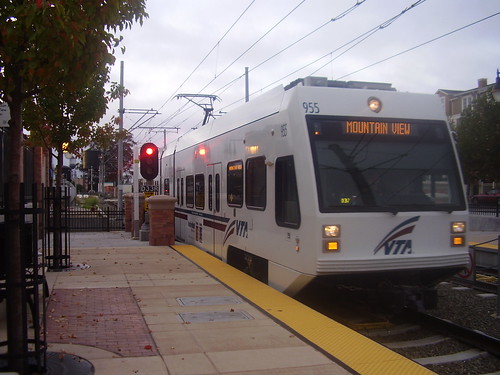
Ultimately, my decision as to where to relocate was not based solely on the modes of transportation available, though the options in the bay area did make the transition to a newfound independence a little easier and more enjoyable (like I said, I really like underground trains). Imagine my joy when, having just arrived from a stronghold of suburban America where I was one of the few supporters of the little bus system that could, I suddenly found at my doorstep: the BART! the Muni! the Caltrain! Not to mention the VTA light rail that runs from Mountain View to San José, which I haven't tried yet, but I look forward to it!


[bart train in richmond]


[muni n-judah at church & duboce in san francisco]

[caltrain in palo alto]

When I lived in Provo, I came to love the sound of the freight train whistle that always reached me in the middle of the night. Here in Palo Alto, I find the sound of the Caltrain whistle comforting. While I lived in San Francisco, I fell asleep listening to the soothing electric whirr of the Muni light rail which stopped half a block away.

Every day I take the Marguerite shuttle to work. Every Sunday I take the Caltrain and the Muni to church. I don't even own a car. That's mostly for financial reasons, but also I'm blessed to live in an area where it's not really necessary. My home address scores a 92 out of 100 on the Walkscore scale - that's a walker's paradise! And I must say it is a lovely neighborhood to walk in. It's nice to be able to run errands on foot, and I feel good about keeping my carbon footprint from becoming unnecessarily enormous. Even though my family isn't fanatically "green," we have been recycling since I was in kindergarten, and after all, I did grow up in Maryland public schools. We had regular programs entreating us to save the bay. In recent years my eco-consciousness has become more prominent, partly in answer to the volume of voices speaking up about global warming, partly because it fits in naturally with my fairly simple lifestyle anyway, partly because I've gained a greater sense of responsibility in all aspects of my life, partly because it's sort of stylish, partly because I moved to California and it's easy to do things like buy organic and local produce and to power your home entirely on renewable wind and solar energy.

We live in a nation where many people are used to getting in a car and driving wherever they need to go. If you're one of them, next time you're heading out, I encourage you to try an alternative to driving. Go catch the bus instead; descend into the belly of the earth and discover the experience of slipping through dark tunnels on a high-speed train; hop on the commuter train or the light rail, if your city is blessed with such options. You'll ease the stress on your wallet, on the roads, and on the atmosphere. And who knows, you might just meet someone wonderful who happens to sit next to you on the train.

Friday, September 26, 2008

skywatch friday, week 7


[machu picchu, peru, 16 june 2007]

more skywatch photos here

Thursday, September 11, 2008

skywatch friday, week 5


[paucartambo, peru, 21 june 2007]

Sorry for the infrequent and verbally sparse posts as of late. I hope to be writing more once I move into my new apartment this weekend.

In the meantime, take a gander at the lovely and interesting skies posted by members of the skywatch community.

Sunday, June 22, 2008

another year older...

Yesterday was the summer solstice. It also happened to be my birthday. You know how when you were little you used to try and convince yourself that suddenly on your birthday you really felt a whole year older than even on the day before? And even after you began to doubt that it worked that way, it still took several more years to accept it. Well, I guess I haven't entirely gotten over it, since I find myself now comparing where I am now not to where I was the day before my birthday (though in a literal sense the two are 1200 miles apart), but rather to where I was a year ago (which again is a difference of several thousand miles, but that's not the point). It's hard to say how far I've come, so to speak, leaving the geographical sense for now. In the last year I finished my master's degree, something that I honestly thought several months ago might not be possible, at least if I didn't care enough to write a thesis (and for a while I didn't). Anyway it is an accomplishment, and one which, depending on my mood and therefore the light that I look at it in, usually seems to me important and makes me feel good about myself. On the other hand, exactly a year ago I had a very clear picture of where I was going and what I was going to do with my life and with whom I was going to share it. When I was in Peru a year ago I told everyone who asked that I was going to get married in the next year or two and that I was going to get a PhD and become a university professor. Since then all of those plans have come crashing down, and now, because I had spent so much time and energy building them up, not only am I totally lost in the rubble, I don't even know what I want to build in their place. Sometimes I feel like I don't want to bother to build anything, since it will probably just fall down before I get to the top floor anyway. Heck, I haven't even cleared away the rubble from the last collapse. I like to think that I am ready for whatever life throws at me next (though I wouldn't go so far as to use the word 'prepared'). I just wish that it would finish warming up and throw it at me already. Because my own powers of reason and my emotions, partly because they're always arguing with each other, are not getting me anywhere except in little spirals.

Sunday, December 16, 2007

notes from sunday school

A few weeks ago I found myself drawing diagrams in my notebook during Sunday school. It was right after Thanksgiving, and the teacher had opened the lesson by inviting a handful of volunteers to share something that they were grateful for. It was a lovely day, and the first thing that came to mind was that I was grateful for sunshine and blue skies. I did not raise my hand to share this, because immediately my mind began following the intricate paths that every once in a while lead it to something fruitful. It went like this: I started thinking about why I am grateful for sunshine and blue skies. First came the obvious: sunshine means light and warmth, which not only allow us to see and keep us from freezing, but also help plants to grow. The sun is the ultimate life preserver, as far as our physical world goes. Blue skies are a little more difficult, since there is nothing inherent in them that keeps us alive. I do, however, find some sort of inarticulable inspiration in their color and depth. Additionally, I am one of those people whose emotions happen to be rather closely tied to atmospheric conditions. Several rainy days or long periods of cloud cover can get me pretty low. This is why I must not move somewhere like Seattle or Ithaca. On the other hand, when I am feeling a little off, sometimes a bright, blue, sunshiny day is enough to put a smile on my face.

Soon I was looking for more specific reasons as to why I find something so simple as a sunny day so wonderful. Where does this joy, that seems to be encapsulated in a sun-brightened, endless blue sky, come from? It occurred to me that, ultimately, it must come from God, since He created the sky and the sun. My mind then journeyed back to Cusco, where I sat in class one morning in June of this year and, when asked something about the difference between traditional Andean polytheism and Judeo-Christian monotheism, I replied that, in a way, I did not find them all that different. Indigenous beliefs in the Andean region hold natural elements like the sun (inti), the moon (quilla), and the mountains (apus) to be gods. In a strict monothestic view, worship of a mountain, for instance, would be considered idolatry. Without going so far as addressing prayers to Mother Earth (Pachamama), however, I believe that we can and ought to recognize the mark of divinity in the mountains, the forests, the stars, in the earth and the sky themselves. When I gaze at the snowcapped Wasatch mountains while I wait at the bus stop, I see God, because those mountains are a product of His creative power. I tried to express this to my teacher, but I had not sufficient time to adequately articulate the thoughts that were forming just then. Although I think that she got the gist of it, I was still unsatisfied with my incomplete explanation.

Months later, in a Sunday school classroom in Provo, it somehow became clear how I might illustrate what I had been trying to say: why immanence makes sense to me. So this is what I drew in my notebook:


As I was thinking more on this topic, this Book of Mormon scripture was recalled to my mind:
But Alma said unto him: Thou hast had signs enough; will ye tempt your God? Will ye say, Show unto me a sign, when ye have the testimony of all these thy brethren, and also all the holy prophets? The scriptures are laid before thee, yea, and all things denote there is a God; yea, even the earth, and all things that are upon the face of it, yea, and its motion, yea, and also all the planets which move in their regular form do witness that there is a Supreme Creator. (Alma 30:44, emphasis added)
I remember teaching this section in gospel doctrine class during the summer after my freshman year at BYU, and while preparing for the lesson I had scribbled in my notes "organic chemistry denotes that there is a God." Which reminds me of a time earlier this year when that same notebook where I drew those diagrams you see above, was witness to some musings of mine about organic chemistry and syntax trees. Maybe another day I'll post that one.