Showing posts with label language. Show all posts

Monday, May 11, 2009

clearly, i do not really know portuguese

I just like to pretend that I do.

Today it was brought to my attention that in my advertising a talk about a Brazilian film, I have been spelling the film's title in two different languages. It starts out in Portuguese just fine—Tropa de—but abruptly switches to French—Élite. 

Oops.

Incidentally, the title of the talk does mention Foucault. So maybe I was just channeling him.

For the record, I don't really know French, either. As with Portuguese, though, that doesn't always stop me from pretending that I do. 

And now that I'm talking about French, I just want to add: isn't Saint-Saëns such a perfect name for a French composer? It just sounds so French (this from the girl who only pretends that she speaks French), and with just a bit of imagination, the Saëns sounds something like song. Plus, he wrote good stuff. So whenever I see or hear the name Saint-Saëns and I proceed to hear in my head that jaunty, guttural French laugh (I don't know how to spell it, but maybe Vanessa does? You know what I mean, right? Think Ha-ha-ha, only rhyming with Saëns), it is a gesture of endearment, mon ami, and not of mocking.

Monday, April 6, 2009

a, b, c, teeheehee

Preface: it's two in the morning, I'm pretty much swimming in yerba mate, and for the last three and a half hours my ears have been bombarded by the very noisy noise of powerwashing coming from the multi-level parking garage behind my house. 

Now then, onto this video that I found extremely amusing. James Earl Jones, take it away:


(via swissmiss)

Thursday, April 2, 2009

hey singles, tired of the bar scene?

Have you considered the laundromat as an alternative?


I just had to share today's Engrish posting because it reminded me of lanudary. Brings a whole new meaning to that made-up word (which I still occasionally see in apartment listings, by the way).

Friday, February 27, 2009

27: climb

As a child, a favorite pastime of mine was jumping off stairs.

On a recent urban mountain-climbing jaunt on Potrero Hill, I found my camera drawn to the stairs leading to other people's houses. I always liked the shapes in staircases: something about that orderly repetitive jaggedness is so pleasing to the eye. The replicated pattern leans and stretches toward infinity.


And now I am thinking: why must we always be going up? We as a people are obsessed with building the tallest structures and scaling the highest mountains. Maybe it is a part of our collective unconscious to associate high places with the heavens, and thus we are drawn to them because something tells us we will be closer to God there. I think it is no coincidence that we equate belief in God or some other-named great spirit with belief in a higher power, where higher may refer both to intangible creative and moral stature as well as to relative physical situation.

On the other hand, our reachings skyward are not always so noble or spiritual. We are obsessed with rising above mediocrity and above the past. We climb the corporate ladder and scale the ranks of academic and government positions. Most commonly, and worst of all, we are obsessed with rising above one another. Where do we think we are going? And why do we insist on doing it alone? What do we expect to gain by getting there before anyone else?

Let us continue to build stairs, but let them be wide enough that more than one person can climb them at a time. And then we'll explore the heights together.

Tuesday, February 24, 2009

24: vanishing still

I am ever the linguistic analyst.

Today's case in point is, well, a matter of two points. Namely: vanishing and focal.

(Note: this post is an extension of yesterday's discussion of vanishing points.)

A vanishing point is the element in an image that creates the impression of infinity. It is the point at which our eyes cease to process an object's presence and our brains fill in the blank with its going on forever. When we look at a vanishing point, we are really looking through it, beyond it.

A focal point, on the other hand, is a spot fixed on something visible. It is inherently tied to the finite. I'm thinking along the lines of a still life rather than a grand detailed architectural drawing.

Vanishing point vs. focal point: it was in church a few Sundays ago that I scribbled the two terms in my notebook. I don't remember whether they were directly related to the specific topic being discussed at the time. Odds are they weren't, but rather through a series of successive associations and tangents, they occurred to me as relevant and worthy of jotting down for the sake of future recall.

The dichotomy is, however, applicable to a gospel topic. Likely it could be applied to a number of gospel topics, but one in particular comes to mind, as I recall a recent conversation with a friend. We were discussing the different approaches to the Atonement that are generally found in our respective churches. In the church she grew up in, the focus was usually on the crucifixion; in the church I belong to, the angle is often toward the resurrection. Both are real and essential parts of the same doctrine; it is only that slight shift in viewpoint that makes for subtleties of meaning.


Consider the following paintings of identical subject matter, with entirely different approaches:

First, Francisco de Zurbarán's Saint Luke as a Painter, Before Christ on the Cross (1630-39):


[click to enlarge]

The crucifixion corresponds to the end of Christ's mortal life. It is a finite event with a clear aspect of completion and a single, inevitable result. When we contemplate the crucifixion, we know what we are looking at. There is one focal point, and it is the culmination of the mortal life of the One who embodied the exemplary blend of humanity and divinity. There is no doubt as to where Saint Luke as a painter (widely believed to represent Zurbarán himself) is directing his focus in this image.


Compare Salvador Dalí's Crucifixion (Corpus Hypercubus) (1954):


[click to enlarge]

Dalí's depiction of the cross is unconventional, to say the least. For our purposes here, what is important is its three-dimensionality and, more specifically, the use of vanishing points to represent the shape in proper perspective. The form is clearly defined; the cross itself does not appear infinite; but still, its edges extending toward vanishing points give it a sense of motion, of continual movement through infinite space and time. This is not a terminal event being commemorated here; it is just one moment in eternity or, in other words, the beginning and the end (the Alpha and Omega): the beginning of immortality born of the end of mortality. The cross's position in mid-air—floating, as it were—almost certainly alludes to the resurrection—the rising from death. Already He is detached from the cross, rising from the crucifixion, because that wasn't really the end. Unlike in the Zurbarán painting above, it is unclear where the observer here is directing her gaze. This is not a completion-based, focal-point-centered image. Death is consumed in the vanishing point and from there new life expands and extends forever, not just for one but for all, everywhere in space and in time.

Thursday, February 19, 2009

19: flower (one who flows)

Back in the day, I played a lot of Scrabble. 

For a while during the last year in G5, three or four games a week was pretty standard. The board frequently came out during thesis breaks or What Not To Wear marathons in OM, too. In contrast, in the nearly seven months since I moved to California, I had not played a single game of Scrabble until last night. 

Without Claire or Vanessa nearby, and without roommates besides my alternate personalities, circumstances apt for Scrabbling present themselves far less frequently than they did in my former life in Utah.

Last night, however, I met a new friend. We're just two people reaching out to one another, breaking out from isolation, seeking a little warmth and unity amid a cold and fragmented society. And arranging lettered tiles on a grid.

The product:


Making words is fun. 
Making friends is delightful. 
Making words with a new friend? Marvelous.

Sunday, February 15, 2009

15: mustered

While in San Francisco yesterday, I spent a good amount of time wandering around Potrero Hill.

At one point I stopped in a little corner market and asked: 
—You wouldn't happen to have any yerba mate, would you?
—What?
—Yerba mate...?
—What? Mustard?
He finally pointed me to the selection of herbal teas. No yerba, of course, but the shop owner suggested Walgreens. I didn't go to Walgreens. I continued on my way, and laughed. I wasn't really expecting to find what I was looking for, but I wasn't expecting that much confusion, either. Silly me, I guess I should have. Nothing like sharing a hot cup of mustard with a friend on a cold rainy day, I suppose.

I had thought that I would find some (yerba, not mustard) in the Mission. I remember having seen a little shop on 24th St with an Argentine flag in its window, but somehow I missed it even as I strolled the length of it between Mission and Potrero. I think it's because I was on the phone with Claire. A worthy distraction, anyway.

After returning home, I sent an email out to a mailing list for area Argentines, asking where they buy their yerba. Instant responses. There seem to be several good options in the area, including a few near Palo Alto, as well as one on 24th in San Francisco—and now I know the cross-street!

Technology can be a wonderful thing.

(photo credit: Gerard Girbes)

Wednesday, February 11, 2009

11: wordbook

I got to hang out with my mom and dad over the weekend, and we reminisced about some early instances of my verbophilia. 

For my fifth birthday my parents gave me a dictionary. A hefty hardcover collegiate dictionary. Now, before you go wondering what on Earth my parents were thinking, I would encourage you to shift your focus to the fact that I asked for a dictionary. Yes, hello! I'm the weird one here. We had a dictionary in the house, of course, but I wanted one of my own that I could keep by my bedside in case I needed to look up a word while reading under the covers at night.

And what did I do when I got that dictionary? I examined the preliminary pages and decided that it would be fun to memorize the Greek alphabet that was listed there. So I did. And it was. And then I took to reciting it backwards. Just for the heck of it. So, you see, in this context, it isn't terribly odd that I used to spend many an evening helping Claire study for her ancient Greek classes. Not only that, but I enjoyed it.

But I digress (is that word of Greek or Latin origin?) Some time before I graduated to that serious dictionary , my mother surprised me with a copy of Richard Scarry's Best Picture Dictionary Ever. When Mom told me what a dictionary was and that she had one for me, my eyes lit up (or so the story goes) and I exclaimed, "You mean there's a whole book with nothing but words in it?!?" This is a ridiculous question, of course, since most books in fact consist entirely of words, but just go with me on this. I was really excited by this dictionary concept. 

I had just gotten out of the bath. Normally, getting dressed immediately follows bathing. But that day there was something far more important to tend to. Wrapped in my bath towel, I crawled into bed and spent all morning and part of the afternoon reading the dictionary. There. I said it.

The German word for dictionary is Wörterbuch: wordbook (Wörter, words, plural of Wort; Buch, book). One of the things I love about German is its generous allowance for compound words, which results in some really elegant and often intuitive combinations. Like Wörterbuch, for instance. Or the word for vocabulary: Wortschatz (Schatz=treasure). Airplane? Flugzeug, flying stuff.

There I go again. And that's barely the start of it. Linguistic curiosities are the kinds of things I find entertaining. Sometimes I seek them out; sometimes they find me. Either way, language has always enjoyed a state of hyperpresence in my world. It is becoming increasingly apparent that I was, in a sense, born for language.

Sunday, January 4, 2009

a year in preview: ABCs of 2009

Ah, the new year's resolutions. I never really liked that terminology. I think it's because the word resolution implies that a person means to do away with a problem that was left unsolved at the end of the last year, possibly due to a broken resolution made at the beginning of the last year. And so the typical new year's resolutions tend to be about the same every year, most items on the list remaining perpetually unresolved.

I am certainly not immune to the allure of new beginnings, but I prefer to think of the new year as a blank page rather than a blank slate. I'm taking pen to paper on a new chapter, not an entirely new book. And I didn't burn everything that my life wrote in previous years.

Well, now that I've set the semantic scenery (a conspicuous linguist am I), I give you now my list of twenty-six goals, predictions, and dreams for this year that we number 2009. Question them, critique them, adapt them into your own lists, make alternate suggestions, mock them; just please, don't call them resolutions. Thank you.

ABCs of skylark's 2009:
Adventuring
Bizarrities
Canadian escapade
Dinner parties
Eccentric acquaintances
Forest exploration
Grad school applications
Hikes with new buddies
Iphone purchase
John Steinbeck pilgrimage
Kiwicha in Bolivia
Long bike rides
Modern dance
New blog
Oboe performance
Published translations
Quechua classes
Romance and heartbreak
Sufjan live
Twitter tweets
Underground art
Vegan experimentation
Weekend in Austin
Xerophyte adoption
Yuppietown to hippietown
Zapateao

Wednesday, December 24, 2008

and the boxcar goes to...

Thanks to all of you who participated in the first ever etxerantz balderdash contest. It was fun to see what you came up with, and many of your answers made me laugh. Out loud. Repeatedly. In a manner that might have been embarrassing had anyone been around to hear it.

It was not easy to choose the winners. But I said that I would, so here we go:


First of all, a bonus point goes to Kim for cross-bread. I don't know about you, but whenever I go to the grocery store I see a number of products that easily fall into the category of cross-breads. Sprouted wheat sourdough with flaxseed, anyone?


Honorable mention goes to Mac for his definition of mysteriopus: 
/mi steeree ō'pəss/ n - a large cat-like carnivorous dinosaur from the Late Cretaceous period whose method of hunting involved spreading mud on the upper part of its face and around its eyes in order to paralyze its prey with suspense. [etymology 'unknown']

Honorable mention goes to Vanessa for both of her entries. Although I had to disqualify mysteri.opus on the grounds that it was not a clearly circumscribed definition, it deserves comment because (1) the film in question might be a good example of a mysteriopus, as Vanessa implies (i.e., a work—in this case, a film—focusing on a mystery), (2) that scene always makes me laugh, and (3) it was uncannily appropriate in light of the fact that when I saw Vanessa's answers I happened to have just finished reading And Then There Were None, which continually made me think of—and want to watch—the movie Clue. 

Vanessa's second definition:
lanudary=wool milk
kind of makes me gag, but it was too charmingly nerdy in its etymological literalness to ignore.


First prize goes to Claire for her definition of mysteriopus:
a many legged (and therefore footed) creature whose leg count has yet to be determined by science.The centipede and millipede look practically footless in comparison.

And the grand prize goes to FoxyJ for her definition of lanudary:
what happens when you need to do laundry but have no clean clothes to wear while doing it; hopefully this doesn't happen in a public place.

The winners do not really get boxcars. Sorry. I know that would be cool. Mostly I picked that word because I like it and it sounds a little like Oscar. FoxyJ wins a Librarian Action Figure with Amazing Push-button Shushing Action (not in its original packaging, but like new. includes stack of accessory books and trading card). Claire wins the pleasure of my company in Toronto, probably sometime in March. Okay, so that was going to happen anyway. I'll bring some other prize, too. I don't know what yet, so it'll be a sur-prize. You honorable mentionees, well, you win all the glory that comes with being mentioned honorably on my blog. 

Thanks for playing, everyone, and Merry Christmas! Look out for the dangers of public lanudary and lurking mysteriopuses.

'Twas the night before Christmas, and all through the edifice
not a creature was stirring, not even a mysteriopus...

Friday, December 19, 2008

balderdash: a call for definitions

Today in my various readings I ran across a couple of curious typos. Typographical errors are not always interesting (and surely to normal people they are never interesting), but these two in particular got me thinking that perhaps a stray keystroke or a moment of slipped typing rhythm can in fact become a felicitous vehicle for a neologism. That's right, careless typing can create new words. The question is, what might such new words mean? How shall we use them?

I hereby issue a call for definitions of the following words:
mysteriopus

lanudary

Please offer a definition of one or both words in the comments section. The composer of the best responses will win a prize! Answers will be judged on creativity, plausibility, laughability, and howmuchilikeitability. Bonus points if you make a typo that results in a new word of the ilk of mysteriopus or lanudary. But it doesn't count if you do it on purpose. Ready, set, go!

Monday, December 15, 2008

my new favorite architect, or, why i should start practicing german again

It all started with this posting on Google Sightseeing: an aerial photo of what turned out to be my new favorite building. (Come to think of it, I'm not sure that I had a favorite building before. But I do now.) The roof takes an unusual shape: a long, curving incline; and it also happens to be green, planted with maple, beech, and lime trees. That's cool enough, and it also explains the building's name, Waldspirale: Wald is German for forest; spirale, as you will have guessed, refers to the spiral shape.

But then! Then I saw this:

(click photo to link to original flickr source)

What splendid craft! What controlled exuberance! What a glorious use of color! Is it...? Could it be...? I think I'm in love.

Waldspirale is an apartment building in Darmstadt, Germany, and for its design we may thank the late Friedensreich Regentag Dunkelbunt Hundertwasser. No, I'm not making that up. Friedrich Stowasser was born in Vienna on this day in 1928, and he adopted a rather more colorful moniker, which translates (rather clunkily) into English as Peace-empire Rainy-day Dark-colored Hundred-water.

Here's another sample of the prolific artist's work:


(click photo to link to original flickr source)

That's the Hundertwasserhaus in Plochingen, Germany. It's not my new favorite, but it certainly has its merits. (Does it remind anyone else of the Spanish missions in California?)

So. If I suddenly take off and move to Germany, you'll have a pretty good idea as to where to find me.


Alles Gute zum Geburtstag, Herr Hundertwasser. Sie lebt noch, im seiner Kunst. Danke.

Thursday, December 11, 2008

without major incident

...but not without a minor one, today for the first time I biked to work. There was a bit of stumbling while crossing the six lanes of El Camino (notice how I make myself feel better by using passive voice?) but overall it worked out very nicely. In fact, it felt great. I haven't quite figured out how all the different speeds work, but at least I can feel cool saying that I have twenty-one of them. And while three and a half miles sounds like very little, I'm pretty sure I'll be worn out by the time I finish the second three-and-a-half home tonight. A healthy, keeping-the-air-clean, making-my-muscles-work, i'm-ready-for-bed-now sort of worn out.

And now, it's flashback time: for me, back to my college German classes when one of my favorite teachers introduced me to Die Prinzen; for some of you, perhaps, back to the early nineties when you secretly wanted to be a groupie for this punked-out German a cappella group. Come on, admit it.

Die Prinzen: "Mein Fahrrad" (My Bicycle)


And by the way, my sister is awesome. This is true for many reasons, but here I point out particularly the fact that mein Fahrrad is actually hers, on super-extended loan until I figure out what I want and save up the cash to buy it. Cool, right?

Monday, December 8, 2008

what's in a name? have a taste and see

Sometimes my brain does very odd things with words. I am not referring to the mildly bizarre, yet simple, word associations like grateful --> full of graters or confusions like did he die in the fire --> upgrade to papaya which, though perhaps surprising, are nevertheless logically traceable in morphological and/or phonetic terms.

No, no, here I am thinking of an even weirder phenomenon.

Exhibit A: Lenscrafters.

Remember Lenscrafters? Sure, they're still around. These days they don't seem to be advertising much, though, at least not like they were a couple of decades ago. Recognize this?


There is really no reason that this ad should be memorable. It's not funny; it's not clever; it's not aesthetically pleasing; it has no catchy theme music. The 3-D graphics--the lab dropping into the store--were pretty cool for their time, I guess, but not spectacular. The apparently 80s fashion may be amusing now, but it's not really all that glaring and, in the 80s, it wasn't really strange.

Nothing, indeed, makes this commercial memorable except that, for me, it conjures up crackers. That seems simple enough, given the visual and aural similarities between the words crafters and crackers. But it's not that simple, I tell you. This unassuming, and really rather boring, commercial, creates for me the impression of a very specific taste. I cannot quite put my finger on it, but it has always been the same, ever since I first saw the ad as a very young child. The best description that I can formulate at the moment is like a sort of stale Saltine cracker that is not very salty and slightly sweet besides.

Seriously. Where does that come from?


Exhibit B: Whitney

Here is another one. It is similar to Exhibit A both in effect and in duration: I can remember experiencing both phenomena since I was about five years old.

However, Exhibit B is, as I see it, far more inexplicable.

I'll keep this compact and posit just the question:

Why should the name Whitney make me think of, and nearly experience, the fragrant, sweet, just slightly tangy taste of vanilla yogurt, specifically the Yoplait variety?

Really.


Does this happen to anyone else?

Friday, December 5, 2008

ten times ten and seven times seven

This is my one-hundredth post on Etxerantz.

As it happens, never in the first ninety-nine posts did I mention where the name etxerantz comes from. It is a Basque word, etxe meaning "house" or "home," -rantz being the directive case suffix (itself a compound of the allative -ra, "(going) to," and the destinitive -rentzat, "for"), indicating "toward." Hence the full title, Etxerantz - Toward Home. Now you know: both where the name comes from, and how nerdy I am. But you probably had a pretty good idea of the latter already.

I wanted to do something special to commemorate my hundredth post. Like it or not, I am conditioned to measure accomplishments in numbers. And the number 100, in our base-ten society and double-is-better culture (like it or not), is kind of a big deal. My first blog topped out at 55 posts before I retired it; interestingly, the next one ended up with exactly 55 posts as well. (In its defense, it was meant to be short-lived, documenting only my five-week stay in Peru.) My photo blog is marching steadily toward its centennial, but, being very young still, shan't celebrate the big three digits until February. Having reached one hundred posts here helps me to be optimistic about the future of this writing space. I hope to celebrate with you many hundreds more.

Let's do one thing at a time, though, shall we? The task at hand is, or at least my desire was, to write a special commemorative centennial post. However, I did not come up with anything meaningfully worthy of such a weighty calling, and rather than spend more time brooding over it, thus unnecessarily delaying the next etxerantz installment--who really cares that it's the one immediately following the ninety-ninth, anyway?--I opted to post something that has nothing to do with the number 100 (though number 3 under the second category comes pretty close).

That said, one might be surprised by how much time and energy I managed to put into what one might have expected to be something of a throwaway blog post. Ah, but I take these silly lists seriously, you see. I'm doing my duty here (not that I don't enjoy it): I was tagged, after all. And I liked Vanessa's variation on the sevens theme. That was a lot of v's. Here's my own slightly modified edition:

7 Things I Can Do:
1. ride a bike
2. write
3. host a slumber party
4. surprise people by speaking Spanish when they least expect it
5. get lost in strange cities (and enjoy the experience thoroughly)
6. play the oboe (and English horn, when I can get my hands on one)
7. cartwheels

7 Things I Cannot Do:
1. speed-read
2. fly a plane
3. control the size of my netflix queue
4. fall asleep with cold feet
5. understand everything
6. ski
7. survive without water

7 Favorite Foods:
1. lomo saltado
2. tacos al pastor
3. tofu
4. pumpkin pie with fresh whipped cream
5. costa pork salad
6. snow day black bean soup (it's kind of a family recipe)
7. chocolate (pretty much any variety, but especially the hot, drinkable kind)

7 Books I am Currently Reading (or at least intending to read in the near future)
1. The Varieties of Religious Experience by William James
2. And Then There Were None by Agatha Christie
3. Casi una mujer by Esmeralda Santiago
4. The House of the Spirits by Isabel Allende
5. Caramelo by Sandra Cisneros
6. The Master and Margarita by Mikhail Bulgakov
7. A Rare Benedictine: The Advent of Brother Cadfael by Ellis Peters

7 Songs That I am Currently Listening to Obsessively *Note: if you follow no other link on this page, you really ought to click on the one labeled "Elephants on Parade." you won't regret it.*
1. Headphones by I'm From Barcelona
2. Airport Surroundings by Loney, Dear
3. Face to Face on High Places by School of Seven Bells
4. To Cure a Weakling Child + Boy/Girl Song by Adem
5. Mirando by Ratatat
6. Elephants on Parade by Podington Bear
7. Incubator by A.R.S.

7 Favorite Words:
1. cacophony
2. luciérnaga (Spanish for firefly)
3. Flugzeug (German for airplane, literally "flying stuff")
4. ma'muaang (my best shot at transliteration. Thai for "mango")
5. matzaqik (Maya K'iche', said at parting and roughly equivalent to "take care;" literally "don't fall")
6. q'omer (Quechua for green. the sound transcribed q' might be my favorite phoneme.)
7. sassafras

7 Travel Destinations Currently High on my Wishlist:
1. Toronto
2. Bolivia
3. Chile
4. Lassen Volcanic Park
5. Iceland
6. Berlin
7. Australia (all of it. yes, I know it's a whole continent. could take a while to save up enough vacation time.)

Wednesday, November 19, 2008

well that's great

In my readings lately (in blogs, emails, newspapers, and what have you), I have frequently come across the word grateful. 

Probably not abnormally frequently, but for some reason the word has stood out to me. 

It is not because I am particularly aware of the gratitude that I personally feel at this time in my life. I do, and I suppose that I am, but, at least consciously, that is not the reason behind all these gratefuls jumping out at me.

No, but rather because of some odd dance of neurons in my head it keeps occurring to me that grateful must mean full of grates. And yet I don't even picture grates. I picture graters.

That doesn't even make sense. The word is not graterful, after all.

The human brain can be so weird. You can expect more from me on this theme (meaning the brain's weirdnesses, and not necessarily graters, but perhaps grates) in the future.

Wednesday, November 12, 2008

we're better blacksmiths than you are!


[embarcadero between brannan & bryant, san francisco]

Does anybody else get the sense that must be their official slogan?

Wednesday, November 5, 2008

some thoughts for the next (first) day

November 5, 2008: yesterday was a pretty important day here in the United States of America. Today is a brand new day; today I, along with millions of fellow citizens, residents, visitors, as well as onlookers in other countries, rejoice in the naming of the new President-Elect, Barack Obama. This is the start of a period of healing and renewal and progress. Watching Obama's speech last night, I had to keep reminding myself that it was real, that it wasn't just a fairy tale playing on the screen.

The result of the presidential election, however comforting and awe-inspiring, did not come as a surprise to me. What does surprise me is the result of the vote on California Proposition 8. I really did not expect it to pass. I noticed the extra push by the No on Prop 8 campaigners in the last few days leading up to the election, but I couldn't imagine that their efforts were anything more than a security buffer.

You may remember that I had a hard time with Proposition 8 when I first moved to California in August. Well, I still do. Either way I look at it, it makes me upset. I don't fully understand it, and I cannot tell what will happen in the future as regards this issue. Ultimately, my vote on Prop 8 came down to a matter of trust in the prophet and apostles of the Church, trust that they are blessed with greater foresight than I, trust that they know what they are doing, trust that they would not endorse a particular position on a particular political issue if it were not very important for some reason(s) that I do not yet understand.

Am I happy that Prop 8 passed? No, decidedly not. Would I be happy if Prop 8 had not passed? I'm not sure. Maybe, at least in the short term. The good that I see coming from the passage of Prop 8 is that it will not last. I know it won't. Too many people are upset and hurt (and can you blame them?) and they will not sit back and say 'oh well, we tried.' We will be called to vote again, we will be called to act, we will be called to enact a change that is really functional. I don't yet know what it will be, but I believe that after several incarnations of prop 8's and counter-prop 8's, we may eventually hit upon something that everyone can agree on. Call me a foolish idealist if you will. All I know is that it's not working now. But that doesn't mean that we should give up hope. Hasn't the Obama campaign taught us anything, after all?


What follows is a text that I originally wrote in an email to a friend, since we had earlier begun a conversation on the topic. When I came to the end (which is far from an end to the discussion), I realized and commented that perhaps it was a little silly to be writing this in an email. While my primary intent was to renew our dialogue, the primary effect was that, even before receiving a response and yet ignorant of whether my friend would even read what I had written, I felt better (if ever so slightly) just having gotten my thoughts out on paper, so to speak. Writing is mostly narcissistic. But every once in a while it transcends. And our stubborn hope in that once-in-a-while, I suppose, is what propels us humans to continue sharing our writing, somehow or another.
To be sure, I do not feel "vindicated" or even, more mildly, "justified" by the outcome of the prop 8 vote, nor do I feel any sense of relief. I do stand by my decision to follow my church leaders' counsel in voting on the issue, but I never did feel comfortable asking others to vote as I would (and therefore I did not). To be honest, the whole issue makes me feel sick, literally sick to my stomach. Part of me wants to run away from it, but mostly that tells me that it is important and must be dealt with somehow.

Regardless of which way the vote went, the very fact that it was so close tells me that this is not a simple black-or-white issue. Though others who voted "yes" may rejoice that we "won," I know that's simply foolish. I know very well that this is not the last we will hear of it, nor is it the last time it will come up on a ballot. Besides, the way I see it, democracy ought not to be about winning or losing. Something's wrong if we're fighting. If an issue is so starkly divided, that to me means that neither side is wholly right. There must be some other resolution that will make everybody better off.

Frankly, I think that we are in need of major reforms, more revolutionary perhaps than legalizing same-sex marriages. Under the law, take away the right to marry from everyone. Let any two people establish a civil union and enjoy the legal (and equal) rights that come along with that, and leave marriage entirely up to the churches. It's a semantic issue, perhaps, a matter of names. But what's in a name? For me (the phrase "the Word was God" comes to mind, not to mention my linguistic/literary background), words, names, are very important and far from empty; it seems, too, that I am not alone: a lot of the emotion surrounding the prop 8 issue, I believe, stems from the meaning(s) we attribute to the word "marriage" itself.

This is just the beginning. I do not know what will happen next, but we will continue to live in the struggle.


La vida es lucha, y la solidaridad para la vida es lucha y se hace en la lucha. No me cansaré de repetir que lo que más nos une a los hombres unos con otros son nuestras discordias. Y lo que más le une a cada uno consigo mismo, lo que hace la unidad íntima de nuestra vida, son nuestras discordias íntimas, las contradicciones interiores de nuestras discordias.

Miguel de Unamuno, La agonía del cristianismo

Thursday, October 30, 2008

peoplemovers

I have long nurtured a fascination with mass transit systems. I can't quite say why, nor can I pinpoint when it started, but I think I first became conscious of it while studying abroad in Alcalá de Henares, a suburb of Madrid.

A "suburb" in Spanish is called a cercanía, and Cercanías is what they call the regional rail networks in Spain. The Cercanías trains are what we would take from Alcalá to get into Madrid. It was four years ago, but if I stop to think about it, I can still hear the voice that announces the stops in that beautiful Castilian Spanish, theta and all: Próxima parada: Torrejón de Ardoz.

My love for the Madrid Metro was instantaneous. One of the oldest Metro systems in the world (first opened in 1919), it's sleek, efficient and enormous. My explorer buddy and I had many an adventure navigating the capital city via its underground labyrinth of Atochas and Sols and Nuevos Ministerios. Years later, while Julie was again living in Spain, she sent me the link to Red Retro: a sort of underground (pun intended) guerrilla art project involving altering the names of Metro stations. A delightful endeavor, if you ask me.

When we arrived in Barcelona at the end of our 2004 stay in Spain, we realized just how accustomed we had become to the Madrid Metro: we experienced some embarrassing difficulty entering the Barcelona Metro, since the turnstyles, in relation to where you inserted your ticket, were oriented opposite the way they had been in Madrid. The Barcelona Metro has a different flavor: it's smaller than Madrid's, and everything is in three languages. The Catalan influence means that "RENFE" (originally an acronym for the Spanish National Rail Network) is pronounced with a schwa at the end (which is a shocking phenomenon when you have been hearing only Spanish for the last three months), and that Metro stations have names like Paral•lel. Yes, that's really how it's spelled.

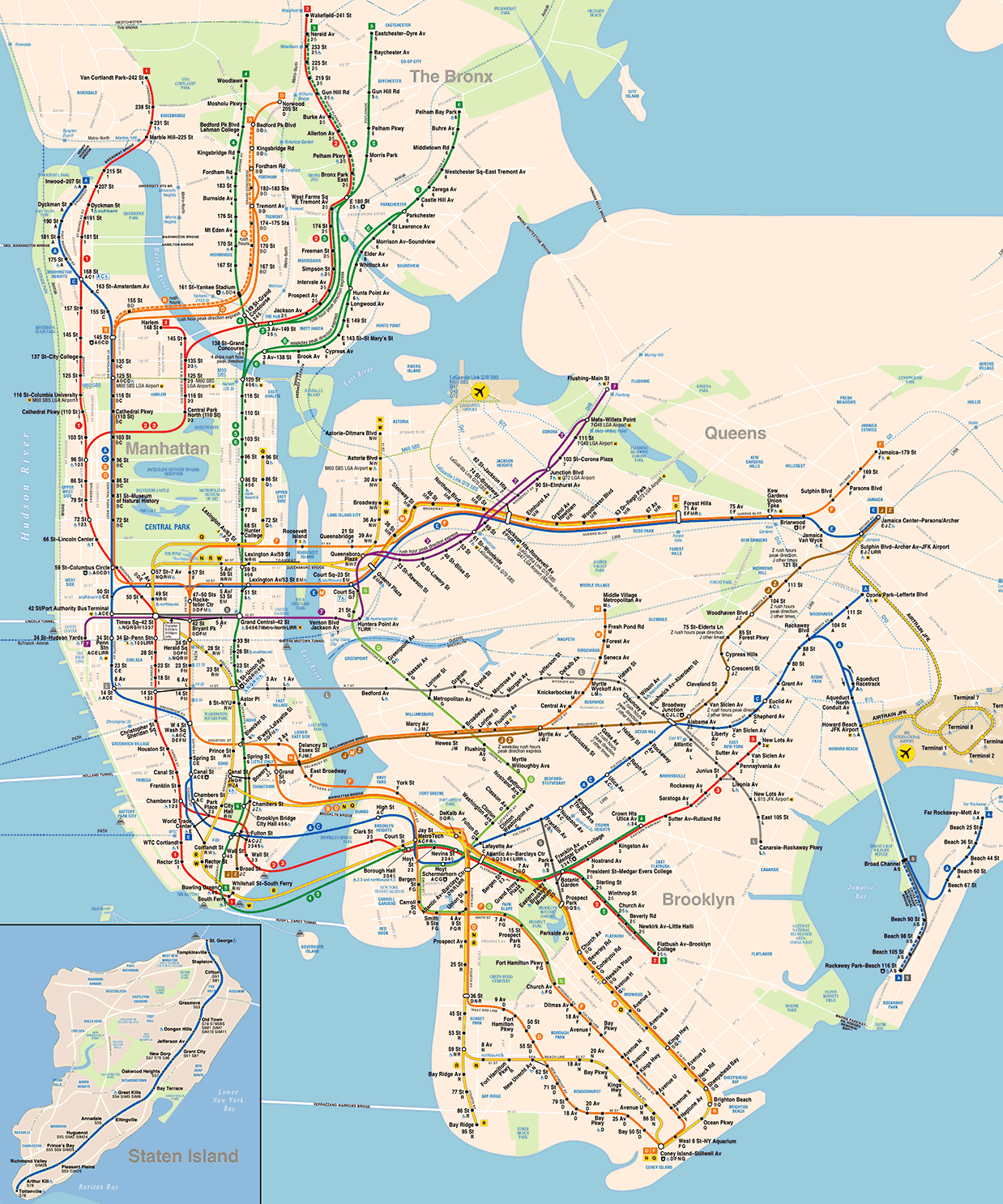
I take a certain pride in having experienced several mass transit systems around the world, from the smooth and sometimes architecturally grandiose Washington DC Metro of my homeland, the somewhat chaotic New York City Subway, the aging T of Boston, the endearing UTA buses in my last area and the promising TRAX light rail in Salt Lake City, Chicago's El trains and Metra commuter rail (which we like to think of as a female Metro), to the reeling speed-racing buses in Mérida and the extremely inexpensive but also very scary "buses" (really just rickety vans crammed with a couple dozen people) in Cusco.

Earlier this year, while I was trying to figure out where I would move to, my research included scoping out the transportation options in a number of potential cities. Underground rail got lots of bonus points, while lightrail and commuter rail were pluses, and buses, well, buses are better than nothing. Somewhere along the line, I came across this website highlighting artistic and architecturally interesting Metro systems around the world. Yes, that is the kind of thing that catches my eye. That said, it shouldn't surprise you that, the first time I visited the Stanford library, I discovered this marvelous book and spent a good couple of hours devouring it.

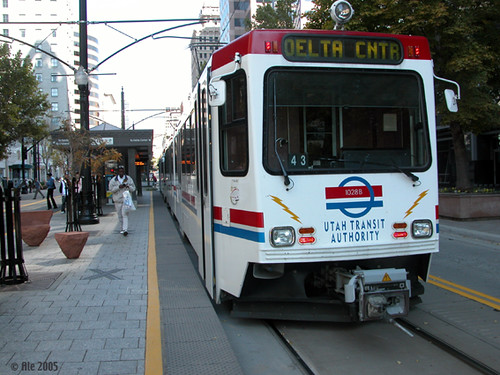
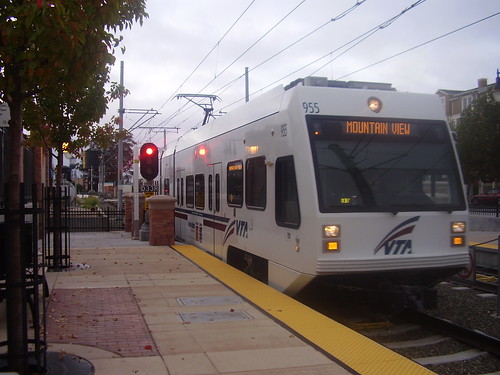
Ultimately, my decision as to where to relocate was not based solely on the modes of transportation available, though the options in the bay area did make the transition to a newfound independence a little easier and more enjoyable (like I said, I really like underground trains). Imagine my joy when, having just arrived from a stronghold of suburban America where I was one of the few supporters of the little bus system that could, I suddenly found at my doorstep: the BART! the Muni! the Caltrain! Not to mention the VTA light rail that runs from Mountain View to San José, which I haven't tried yet, but I look forward to it!


[bart train in richmond]


[muni n-judah at church & duboce in san francisco]

[caltrain in palo alto]

When I lived in Provo, I came to love the sound of the freight train whistle that always reached me in the middle of the night. Here in Palo Alto, I find the sound of the Caltrain whistle comforting. While I lived in San Francisco, I fell asleep listening to the soothing electric whirr of the Muni light rail which stopped half a block away.

Every day I take the Marguerite shuttle to work. Every Sunday I take the Caltrain and the Muni to church. I don't even own a car. That's mostly for financial reasons, but also I'm blessed to live in an area where it's not really necessary. My home address scores a 92 out of 100 on the Walkscore scale - that's a walker's paradise! And I must say it is a lovely neighborhood to walk in. It's nice to be able to run errands on foot, and I feel good about keeping my carbon footprint from becoming unnecessarily enormous. Even though my family isn't fanatically "green," we have been recycling since I was in kindergarten, and after all, I did grow up in Maryland public schools. We had regular programs entreating us to save the bay. In recent years my eco-consciousness has become more prominent, partly in answer to the volume of voices speaking up about global warming, partly because it fits in naturally with my fairly simple lifestyle anyway, partly because I've gained a greater sense of responsibility in all aspects of my life, partly because it's sort of stylish, partly because I moved to California and it's easy to do things like buy organic and local produce and to power your home entirely on renewable wind and solar energy.

We live in a nation where many people are used to getting in a car and driving wherever they need to go. If you're one of them, next time you're heading out, I encourage you to try an alternative to driving. Go catch the bus instead; descend into the belly of the earth and discover the experience of slipping through dark tunnels on a high-speed train; hop on the commuter train or the light rail, if your city is blessed with such options. You'll ease the stress on your wallet, on the roads, and on the atmosphere. And who knows, you might just meet someone wonderful who happens to sit next to you on the train.

Thursday, October 23, 2008

skywatch friday, week 11


"And they said, Go to, let us build a city and a tower, whose top may reach unto heaven; and let us make us a name..."

[stanford, ca]

see more skies, both ordinary and spectacular, at skywatch